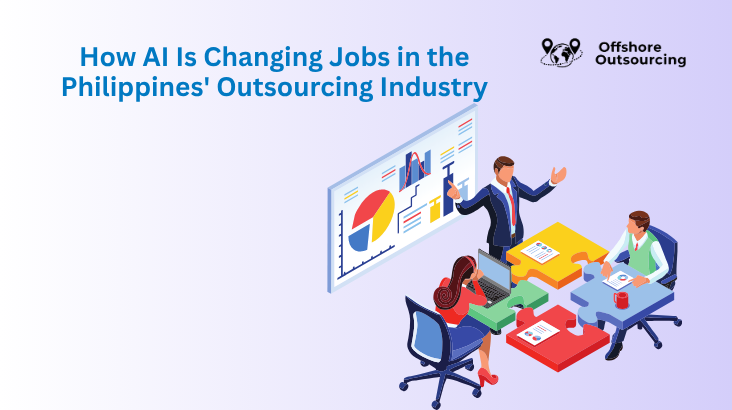
Every conversation about the Philippine BPO sector eventually circles back to one worry: is AI quietly taking jobs away? A 2025 IMF working paper found that roughly a third of Filipino workers face high AI exposure, though 61% of those roles are also rated highly complementary to AI. AI in Philippines’ outsourcing Industry conversations need that nuance, not just headline panic. This blog looks honestly at what’s actually changing, and what it really means for people doing the work every day. How AI Is Actually Reshaping Daily Work in the Sector Automation hasn’t wiped out entry-level roles the way early predictions loudly warned it would. Instead, it’s quietly reshaping how those same roles function day to day. The shift in AI in Philippines’ outsourcing Industry work is subtle, but it’s showing up everywhere once you look closely. · Repetitive Tasks Are Getting Automated First Data entry, basic transcription, and routine email replies are the tasks AI handles fastest and most reliably. Workers doing this kind of work aren’t disappearing; they’re shifting toward reviewing and correcting AI output instead. That shift changes the skill set required, even when the job title on paper stays exactly the same. · Voice-Based Roles Face the Steepest Pressure Contact center positions built around scripted, transactional calls are seeing the heaviest AI-driven disruption right now. One widely cited industry estimate puts roughly 53,000 Philippine BPO positions at meaningful automation risk (source). That number sounds alarming at first, but it’s actually well under three per cent of an industry employing 1.9 million Filipinos today. · New Roles Are Emerging Positions in AI operations, data annotation, quality review, and prompt optimization keep appearing across the sector steadily. IBPAP data shows 56% of member firms have already folded AI tools into their daily operations. Most describe the shift honestly as augmentation, not replacement, based on what industry leaders keep saying publicly. Which Roles Are Actually Changing the Fastest Not every job is affected by AI in Philippines’ outsourcing Industry equally. A few categories stand out clearly once you look at where hiring and retraining money is going. Basic data entry and back-office processing roles are shifting toward AI-assisted review work Customer support agents are moving from scripted calls toward complex, judgment-based case handling Bookkeeping and finance support roles increasingly involve checking AI-generated reports for accuracy Quality assurance positions keep expanding, since AI output still needs consistent human oversight Technical roles supporting AI tools and automation platforms are growing steadily across firms AI in Philippines’ outsourcing Industry shifts like these explain why total employment keeps climbing even as individual tasks quietly get automated underneath. How Filipino Talent Is Adapting to Stay Ahead The workforce response here has been fast, not reactive, which honestly matters more than most headlines suggest. Government and industry bodies are treating reskilling as genuinely urgent, not some optional side project. · Upskilling Programs Spreading Rapidly IBPAP has invested at least $25 million annually in workforce upskilling programs within the entire industry (Source). Projects such as Project UNLAD are sponsored by government agencies in order to foster digital skills needed for the future. AI Tech Academy, run by PEZA in Cebu, is another example of that. · Fluency in AI Is Now Preferred Firms prefer workers who will be able to work alongside AI technologies rather than those who are just typing quickly without AI. Adaptability and good judgment rather than speed are more valuable now for employers. AI in Philippines‘ outsourcing industry has definitely shifted in this direction over the last two years. Growth Projections Continue to Emphasize Employment Increase Roadmap by IBPAP calls for employment of 2.5 million workers and $59 billion worth of revenues in 2028 (Source). This projection implies widespread adoption of AI technology in the industry, not its absence, which speaks volumes. AI in Philippines’ outsourcing Industry growth and workforce expansion appear to be moving together right now, not against each other. · What This Means for Businesses Outsourcing Here Businesses collaborating with BPO companies in the Philippines will benefit from this change that comes with AI in Philippines’ outsourcing Industry. Groups that analyze the work of artificial intelligence, handle exceptions and make judgments do better in terms of precision than groups of either type alone. This is turning out to be the true competitive advantage that enables further growth in the entire industry. Conclusion The Filipino outsourcing labor force is not shrinking because of AI; it is developing along with it. Companies collaborating with prepared teams experience benefits as this process continues to take place.