Blog

Blog

Engineering Outsourcing in the Philippines

Finding good engineers close to home keeps getting harder, and pricier too. That’s part of why engineering outsourcing in the Philippines has turned into a real strategy, not just a backup plan, for companies trying to build products without blowing their budget. Why Companies Keep Looking Toward the Philippines Talent shortages in engineering have pushed a lot of businesses to look past their own borders. Over the past decade, the Philippines has earned a solid reputation as a place worth looking. ·        A Steady Supply of Technical Talent Filipino universities turn out over 500,000 business and tech graduates every year, and that number keeps climbing. Companies get a dependable pool of engineers who can join a project without a long ramp-up period. ·        English Fluency Makes Things Simpler With a 90% literacy rate, technical conversations rarely get muddled or lost in translation. That matters a lot once engineers and clients start working across different time zones day after day. The Cost Story People Care About While Outsourcing from the Philippines Let’s be honest, budget is usually the first reason anyone considers outsourcing engineering work overseas. Engineering outsourcing Philippines partnerships tend to deliver savings that are genuinely tough to match anywhere else. ·        Real Savings, Not Just Marketing Talk Companies working with Filipino engineering teams report savings of 60% to 70% compared to hiring in the US. That’s real money businesses can put back into product development instead of payroll. ·        A Market That’s No Longer Small The Philippine IT-BPM sector pulled in 38 billion dollars in 2024 and is expected to hit 59 billion by 2028. Growth like that says this industry has matured well past being a short-term cost hack. What Outsourced Engineering Teams Actually Bring to the Table Nobody outsources purely to save a few dollars anymore; they want real skill behind the work too. Outsourced engineering services coming out of the Philippines now cover a lot more ground than basic coding tasks. ·        Handling the Whole Development Cycle Filipino teams often manage everything from early design work through testing and final deployment. Many specialize in software builds, hardware integration, and systems architecture for clients scattered around the world. ·        Filling Gaps That Are Hard to Close Locally Beyond general development, Filipino engineers increasingly work in cybersecurity, fintech, and data analytics too. That kind of specialization saves companies months they’d otherwise spend trying to hire locally for the same skills. ·        Work That Never Really Stops Time zone gaps mean outsourced teams keep pushing projects forward while headquarters staff is fast asleep. It stretches the working day without asking anyone to clock extra hours to make it happen. Building an Outsourcing Partnership That Actually Lasts Saving money is nice, but most companies end up caring more about consistency and trust over time. Good engineering outsourcing in the Philippines takes more thought than just picking whoever quotes the lowest price. ·        Communication Has to Be Built In Regular check-ins, shared project tools, and documented workflows keep distributed teams from drifting apart. Teams that set these habits early almost always run into fewer delays and fewer awkward surprises later. ·        Think Beyond the First Project The strongest partnerships eventually stop feeling like outsourcing and start feeling like an extension of the in-house team. Businesses that treat it that way tend to get the best results over the long run. Engineering talent gaps aren’t going away, and hiring at home isn’t getting any cheaper. The Philippines offers a mix of skilled people, strong English, and real cost savings that’s genuinely hard to ignore. Conclusion Companies willing to put in the effort to pick the right partner and build solid communication habits usually come out ahead. Outsourced engineering services from the Philippines aren’t a stopgap anymore for a lot of global businesses; they’re just how things get built now.
Data Entry Automation

Bad data costs money, and slow data costs even more. Data entry automation fixes both problems by letting software capture, check, and file information instead of a tired employee typing it by hand. Businesses that switch see fewer typos, faster reports, and lower labour bills within months. This guide explains why manual entry fails, the tools that replace it, and how to get started today. How Manual Data Management Slows Down Business Processes Manual data entry involves the need for workers to scan, enter, and review huge amounts of data, making errors more likely to occur. A single typo in an address or invoice number rarely stays small. Travels into shipping, billing, and reporting systems Multiplies into refunds, late deliveries, and confused customers A 2025 IBM report found 26% of businesses expect losses over $5 million a year from poor data quality, and 7% expect losses over $25 million (source) That kind of loss usually starts with something as small as a mistyped field This is why many companies now turn to data entry automation services to handle high-volume paperwork without adding staff or burning out the team already in place. What Are the 4 Types of Data Entry Automation? Data entry automation is technology that captures, checks, and enters information into digital systems without someone typing it by hand. It generally falls into four types, and picking the right one matters more than picking the trendiest tool. Robotics Process Automation (RPA): The process of RPA involves using software robots to automate rule-based activities. Optical Character Recognition (OCR): This term refers to an electronic process through which scanned images, PDFs, or even handwritten documents can be converted into machine-readable format. Machine Learning (ML): This refers to the process of analysing past records to identify patterns and flag anomalies in the entries. AI-based systems: Combine several of the above, adding judgment for messy or unstructured documents that plain rules cannot handle. Most businesses end up blending two or three of these rather than picking just one, matching the tool to the mess it needs to sort out. How AI Minimises Data Entry Mistakes AI reduces human data-entry errors. Automated checks catch discrepancies instantly. ●       Automated Pattern Recognition AI models learn correct information from thousands of historical records. They can identify a phone number in the wrong field or an invoice total that doesn’t match its item prices in near real time. ●       Real-Time Error Flagging When something looks off, the system flags it for a human to check or corrects it on the spot using patterns from similar records. This catches errors before they reach a database, not weeks later during an audit. ●       Growing Enterprise Adoption Adoption is picking up speed too. According to the data released by the US Census Bureau, AI adoption by U.S.-based organizations increased from 17 percent to 20 percent between December 2025 and May 20 (source).. Companies expect this rate to increase within the next six months. ●       Multi-Tool Verification More companies now pair OCR with machine learning in their data entry automation solutions, since the combination catches both messy handwriting and logical errors that a single tool would miss on its own. Best Practices for Data Entry Automation Knowing how to automate data entry well starts long before anyone installs new software. A few habits separate teams that see real savings from teams that waste a budget on tools nobody uses. Map the workflow first. List every field, form, and handoff in the current process before choosing a tool, so the automation actually fits the work. Start with one process. Select one high-volume task, such as processing monthly invoices, and test the automated process alongside the existing workflow. Train the team properly. Teach your staff how to inspect flagged items and handle exceptions, since even an effective automated program sometimes needs a human touch. Monitor and adjust. Review error rates regularly and update rules, workflows, or AI models as document types and volumes change. Skipping any one of these steps is usually why an automation project stalls halfway through. Conclusion Manual typing carries a risk of error, and that risk can increase as data volumes and business processes become more complex. Software that checks, matches, and files data does not get tired at 4 PM. Start small, measure the results, and let the numbers guide how far the automation goes from there.

Which One Should You Choose: Outsourcing, Offshoring, or Offshore Outsourcing?

Struggling to balance soaring operational costs with the constant demand for fast, accurate execution? The solution lies in strategic delegation, but navigating choices like outsourcing services or offshoring ones can quickly get confusing. So, reading the guide and choosing the right path requires matching your budget. Outsourcing vs Offshoring vs Offshore Outsourcing: What Is the Difference? Outsourcing refers to the act of employing third-party companies in charge of departments or tasks, such as payroll or customer care. The provider can sit in your own country or another one. What changes is who does the work, not where they sit. Offshoring means moving part of your own business, such as a support team or a manufacturing line, to another country. You still own it, staff it, and run it day to day. Offshore outsourcing in India mixes the two. You hand a task to a vendor based abroad, and that vendor hires the staff, sets up the tools, and runs the process for you. Factor Outsourcing Offshoring Offshore Outsourcing Location Same country or nearby Different country, your own setup Different country, vendor’s setup Control Shared with the vendor Stays fully with you Mostly with the vendor Cost Moderate savings High upfront cost, savings over time Lowest upfront cost, fast savings Communication Easy, similar time zone Time zone gap, your team manages it Time zone gap, vendor manages it Talent access Local or regional pool Global, but you build the team Global, vendor already has the team Common use cases Payroll, IT helpdesk, support Manufacturing plants, R&D centers, GCCs Call centers, software builds, back office The table shows where the three models pull apart. Location decides how far the work travels. Control decides who answers for the result. Cost decides how fast a business sees savings. Most companies pick their model based on these three factors alone. When Should You Choose Outsourcing Services? Outsourcing services fit best when a task is routine and not central to what makes your business different. Payroll, bookkeeping, IT helpdesk work, and basic customer support are common picks. Here’s the thing: you’re not building a department, you’re renting one. So, choose this route when: You need the work done, but not a full-time employee. The work follows a set process with little oversight You want to control costs without a long contract Speed matters more than owning the team That’s also why many companies exploring cost-effective support start small, then grow the scope once the results hold up. When Does Offshoring Make More Sense? Offshoring fits companies that want a real, lasting presence abroad, not just a task handed off. It suits work that sits close to the core of the business, where quality and culture matter as much as cost. Choose this route when: The work is central, like product engineering or R&D Leadership wants direct say over hiring and training The plan is to grow a team steadily over several years Setting up a legal entity abroad is worth the investment A company opening its own engineering hub in another country, often called a Global Capability Center, is offshoring in its clearest form. Some businesses test the idea first through outsourcing to India on a smaller scope, then move to a full offshore setup once the model proves itself. When Is Offshore Outsourcing the Better Choice? Offshore outsourcing works when a business wants the savings of going abroad without managing offshore staff itself. A vendor hires, trains, and runs the team, while your business sets the goals and checks the output. When talking about outsourcing to India, NASSCOM statistics quoted by the India Brand Equity Foundation highlight remarkable growth. India’s IT sector revenue is predicted to rise from $181 billion in FY19 to approximately $315.4 billion in FY26, with export revenue reaching $246.4 billion. (Source). So, choose this route when: The task needs skills that cost less to access abroad You want to test a new service without a big upfront spend Round-the-clock coverage across time zones is a priority Paying for output beats managing day-to-day staffing Conclusion Even though outsourcing, offshoring, and offshore outsourcing are different approaches, they all save money. Make sure you choose the right method, the time and the speed required. Start your project as small as possible, and then expand later if you are successful.

AI Is Changing Jobs in the Philippines

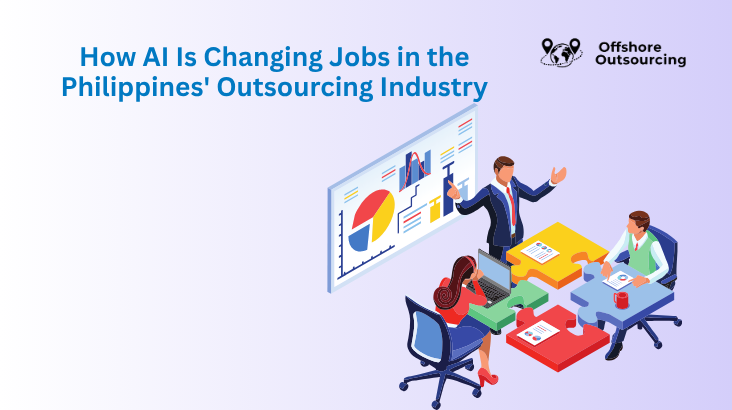
Every conversation about the Philippine BPO sector eventually circles back to one worry: is AI quietly taking jobs away? A 2025 IMF working paper found that roughly a third of Filipino workers face high AI exposure, though 61% of those roles are also rated highly complementary to AI. AI in Philippines’ outsourcing Industry conversations need that nuance, not just headline panic. This blog looks honestly at what’s actually changing, and what it really means for people doing the work every day. How AI Is Actually Reshaping Daily Work in the Sector Automation hasn’t wiped out entry-level roles the way early predictions loudly warned it would. Instead, it’s quietly reshaping how those same roles function day to day. The shift in AI in Philippines’ outsourcing Industry work is subtle, but it’s showing up everywhere once you look closely. ·        Repetitive Tasks Are Getting Automated First Data entry, basic transcription, and routine email replies are the tasks AI handles fastest and most reliably. Workers doing this kind of work aren’t disappearing; they’re shifting toward reviewing and correcting AI output instead. That shift changes the skill set required, even when the job title on paper stays exactly the same. ·        Voice-Based Roles Face the Steepest Pressure Contact center positions built around scripted, transactional calls are seeing the heaviest AI-driven disruption right now. One widely cited industry estimate puts roughly 53,000 Philippine BPO positions at meaningful automation risk (source). That number sounds alarming at first, but it’s actually well under three per cent of an industry employing 1.9 million Filipinos today. ·        New Roles Are Emerging Positions in AI operations, data annotation, quality review, and prompt optimization keep appearing across the sector steadily. IBPAP data shows 56% of member firms have already folded AI tools into their daily operations. Most describe the shift honestly as augmentation, not replacement, based on what industry leaders keep saying publicly. Which Roles Are Actually Changing the Fastest Not every job is affected by AI in Philippines’ outsourcing Industry equally. A few categories stand out clearly once you look at where hiring and retraining money is going. Basic data entry and back-office processing roles are shifting toward AI-assisted review work Customer support agents are moving from scripted calls toward complex, judgment-based case handling Bookkeeping and finance support roles increasingly involve checking AI-generated reports for accuracy Quality assurance positions keep expanding, since AI output still needs consistent human oversight Technical roles supporting AI tools and automation platforms are growing steadily across firms AI in Philippines’ outsourcing Industry shifts like these explain why total employment keeps climbing even as individual tasks quietly get automated underneath. How Filipino Talent Is Adapting to Stay Ahead The workforce response here has been fast, not reactive, which honestly matters more than most headlines suggest. Government and industry bodies are treating reskilling as genuinely urgent, not some optional side project. ·        Upskilling Programs Spreading Rapidly IBPAP has invested at least $25 million annually in workforce upskilling programs within the entire industry (Source). Projects such as Project UNLAD are sponsored by government agencies in order to foster digital skills needed for the future. AI Tech Academy, run by PEZA in Cebu, is another example of that. ·        Fluency in AI Is Now Preferred Firms prefer workers who will be able to work alongside AI technologies rather than those who are just typing quickly without AI. Adaptability and good judgment rather than speed are more valuable now for employers. AI in Philippines‘ outsourcing industry has definitely shifted in this direction over the last two years. Growth Projections Continue to Emphasize Employment Increase Roadmap by IBPAP calls for employment of 2.5 million workers and $59 billion worth of revenues in 2028 (Source). This projection implies widespread adoption of AI technology in the industry, not its absence, which speaks volumes. AI in Philippines’ outsourcing Industry growth and workforce expansion appear to be moving together right now, not against each other. ·        What This Means for Businesses Outsourcing Here Businesses collaborating with BPO companies in the Philippines will benefit from this change that comes with AI in Philippines’ outsourcing Industry. Groups that analyze the work of artificial intelligence, handle exceptions and make judgments do better in terms of precision than groups of either type alone. This is turning out to be the true competitive advantage that enables further growth in the entire industry. Conclusion The Filipino outsourcing labor force is not shrinking because of AI; it is developing along with it. Companies collaborating with prepared teams experience benefits as this process continues to take place.

Why Is Outsourcing to India Considered a Cost-Effective Solution for Startups

Money runs out fast when you’re building something new, and every hire has to justify itself. Outsourcing to India for startups has quietly become the go-to move for founders trying to stretch a small budget further. Skilled professionals, reduced operating costs, and teams that adapt to shifting needs make India a practical choice for businesses building with minimal resources. What Makes Outsourcing to India a Cost-Effective Choice for Startups Cost pressure lands on startups earlier than it does on bigger companies, and it lands harder too. India gives founders a way to breathe a little without giving up on quality. ●       Lower Operational and Labor Costs A full-time hire in the US or UK comes loaded with salary, benefits, and tax obligations that pile up quickly. India’s labor market simply costs less for the same level of skill. Because of that gap, founders can put more money toward the product itself instead of watching it disappear into payroll. ●       Access to Skilled Professionals India turns out a massive number of graduates every year in IT, finance, and data-heavy fields, and that talent doesn’t sit idle for long. Startups rarely wait months to find someone qualified, since the pipeline stays full year-round. Many candidates have already worked with clients abroad, so there’s less hand-holding involved from day one. That kind of head start matters when a small team doesn’t have time to train someone from scratch. ●       Reduced Infrastructure and Technology Expenses Building an in-house team means paying for desks, laptops, and software licenses before anyone even starts working. Outsourcing skips all of that since the provider already has it covered. That alone saves startups from burning through cash during the years when cash is tightest. ●       High-Quality Services at Competitive Pricing A low price tag means nothing if the work falls apart six months in. Indian providers have spent years proving they can hold quality steady while keeping costs reasonable. Grand View Research puts the global business process outsourcing market at USD 328.4 billion in 2025, growing toward USD 695.8 billion by 2033 at a 9.9 percent CAGR. Business Advantages of Outsourcing to India for Startups Saving money gets founders in the door, but the real payoff shows up once outsourcing settles into daily work. Speed, focus, and room to breathe follow soon after. ●       Faster Project Delivery and Operational Efficiency The time difference actually helps here, since work often keeps moving while the home team is asleep. Projects wrap up faster, and nobody has to pull late nights to make that happen. Founders wake up to progress instead of a pile of unfinished tasks waiting on them. ●       Improved Focus on Core Business Activities No individual founder can manage everything simultaneously, irrespective of the amount of time spent. Outsourcing to India takes the repetitive, time-eating tasks off their desk, leaving room for the bigger decisions that actually move the business forward. That shift alone often makes the difference between a team that reacts all day and one that actually plans ahead. ●       Easy Scalability Without Increasing Overhead Costs Startups almost never grow in a straight line, and staffing needs shift constantly because of that. A cost-effective outsourcing solution lets a team grow or shrink on short notice, without the mess of hiring sprees or layoffs. That sort of flexibility ensures that expenses are aligned with the real needs of the business. Founders end up paying only for the resources that they really need, and not some future staffing dream. How to Choose the Right Outsourcing Partner in India Not all service providers stick to the same set of guidelines, which means that selecting the right service provider requires a little research. Consider how long the service provider has been working with foreign clients. Find out how they protect data privacy and confidentiality. Consider the mode of communication and English language skills of your teammates. Seek suggestions or samples from other companies of your size. Maintain honesty in your pricing policy with no hidden costs written in the small print. A bit more effort spent upfront often pays off later. Those startups who are serious about it usually get themselves long-term outsourcing partners rather than temporary ones. Conclusion Outsourcing to India gives startups a realistic way to control costs while still getting access to skilled people and dependable support. As more businesses lean toward flexible, budget-conscious growth, Indian outsourcing partners remain one of the smarter bets for founders building for the long haul.

Pros and cons of Philippines offshore outsourcing in 2026

The Philippines offshore outsourcing industry has changed drastically since its inception several years ago. It has advanced from merely performing routine office work to providing a range of more advanced and AI-powered services. Therefore, it is important to have a good idea of all the pros and cons of this kind of service delivery before making your decision to implement it. How Offshore Outsourcing in the Philippines Has Changed The most prominent trend in today’s offshore outsourcing in Philippines is the transition from performing office work to offering knowledge process outsourcing and other more sophisticated services. Moreover, today the Philippines’ offshore teams use AI in their daily operations, which speeds up the processes while not substituting human employees. Another change is that growth has expanded outside Metro Manila into the Cebu and Davao regions. Pros of Philippines Offshore Outsourcing There are plenty of factors that make it attractive to offshore outsourcing in Philippines today. These are the advantages that consistently make the biggest difference for growing companies. ·        Cost efficiency without any sacrifice Working with Filipino professionals is much cheaper than hiring local workers in the USA, the UK, and Australia. However, considering the benefit in the form of quality, it helps you work with skilled professionals. ·        High proficiency in the English language Communication in the Philippines is generally less problematic compared to other offshore countries. Because it requires less effort from both sides to understand each other when you communicate through English. ·        Availability of highly specialized talent ready for AI projects The workforce has been truly upgraded during recent years. Today, having finance, IT, legal, and data department teams is a usual thing in every company. This is making it more realistic to outsource and hire tech-smart, AI-proficient professionals from the Philippines. ·        Several models of business cooperation In Philippines you get various outsourcing partners. Whether you require a conventional business process outsourcing partner, employer of record, or dedicated in-house-like staff, there is something that suits every company. Cons and Problems You Need to Be Aware of in 2026 The advantages of Philippines offshore outsourcing come with its downsides, though. So, it would be wise to discuss them before signing any papers. The following list will help to identify some potential issues. ·        Time zone considerations Working simultaneously with the US and Europe requires careful scheduling. Understand that real-time collaboration is not always feasible, particularly in cases when it involves lots of live meetings. ·        Privacy and compliance concerns If your industry is highly regulated, you will definitely require a provider that is able to meet regulatory compliance. Adhere to the requirements of both the Philippine Data Privacy Act as well as GDPR or HIPAA in case of your clients from Europe. ·        Increased competition for skilled workers The market has developed, and nowadays it requires more qualified specialists as compared to before. Therefore, the wage for experienced specialists will not be so cheap for your budget as it used to be several years ago. ·        The importance of adequate onboarding You cannot expect that an offshore team will instantly adopt all the processes and tools of your company. Generally speaking, it is more expensive to act in such a hurry in most cases. Is Offshore Outsourcing a Good Deal in 2026? Of course, for those companies that need certain unique skills to scale up their business. By choosing Philippines offshore outsourcing in 2026, you can save money on hiring additional staff. That said, it only pays off when there’s an actual strategy behind it from the planning stage, not just a decision to “go offshore” and figure out the rest later. Treat the factors above as a checklist rather than an afterthought when you’re evaluating offshore outsourcing companies to work with. Conclusion Philippines offshore outsourcing in 2026 has moved well past being a passing trend. For a lot of growing businesses, it’s become close to essential. Done well, it’s one of the most dependable ways to tap into skilled talent without overstaffing your core team.

Top 10 BPO Service Companies in Philippines – August 2026

As one of the world’s most reliable outsourcing destinations, the Philippines is chosen by many businesses, regardless of their size, thanks to its strong English communication, reliable business environment, skilled workforce, and competitive pricing. Currently, business process outsourcing in the Philippines goes far beyond just customer support. Most BPO outsourcing in Philippines provides services such as digital marketing, data processing, IT, software development, finance, content management, healthcare and many other services. Backed by a large talent pool and rising demand from international businesses, industry reports show that the IT-BPM sector in the Philippines will continue to expand. Partnering with the right outsourcing provider can mitigate your operating expenses, increase productivity and enable businesses to focus on growth. However, choosing the best one from hundreds of providers is a challenging task. Therefore, in order to help you choose the right one for your business, we have curated a list of the top 10 BPO service companies in Philippines for August 2026. The companies listed below are recognized for their exceptional service quality, ability to support businesses across different sectors and industry experience. The following list will assist you in getting a trusted partner for your business, whether you need a specialized BPO service in Philippines or complete BPO outsourcing in Philippines.   Top 10 Companies Offering Business Process Outsourcing in Philippines Offshore Outsourcing Philippines The leading BPO service in Philippines, Offshore Outsourcing, focuses on delivering customized solutions, accurate work, and quick turnaround times that enable businesses to increase efficiency while minimizing operational expenses. The company offers a comprehensive suite of outsourcing services such as data entry, digital marketing, accounting, software development, content creation, and back-office support. The experienced and professional team housed in the firm associates closely with the clients to learn about their challenges, specific business requirements, and offers personalized solutions. Back Office Philippines The BPO company offers a wide range of services, including finance and accounting, professional administrative support, virtual assistance, HR outsourcing, and customer service. As the leading BPO outsourcing in the Philippines, Back Office Philippines partners with businesses of different sizes and provides flexible services that streamline regular operations while maintaining security, quality, and reliable communications. As the business requirements grow, this scalable outsourcing model enables businesses to expand their services. Back Office Philippines is a reliable outsourcing partner that emphasizes data confidentiality and consistent service delivery. Data Entry Philippines Specialized in handling bulk volumes of business data with speed and accuracy, Data Entry Philippines is a recognized business process outsourcing in the Philippines that offers data processing, data conversion, data entry, document digitization, database management and image processing. By partnering with Data Entry Philippines, business firms can keep up organized, clean and accessible business records. Moreover, with this company’s quality control process, data reliability can be increased and errors reduced. Businesses save time and enhance its operational efficiency by relying on the services offered by Data Entry Philippines. Outsource2Philippines Businesses looking for affordable and scalable solutions find Outsource2Philippines as an ideal choice. They offer a broad array of services, including web development, customer support, digital marketing, IT services, creative design, finance, and administrative assistance. Through reliable offshore teams, the company focuses on assisting clients in improving productivity. With customized outsourcing solutions, Outsource2Philippines serves startups, small businesses, and large enterprises. The company maintains a client-focused approach that ensures each project is managed with efficiency, transparency and professionalism. Accenture Philippines As one of the largest outsourcing providers in the country, Accenture Philippines offers a diverse range of services, including consulting, technology, cybersecurity, finance, cloud solutions, customer operations, and digital transformation services. Through a highly skilled workforce, automation, and innovation, the company serves global organizations efficiently. To stay current with the latest technologies and industry demands, the company heavily invests in employee training. Businesses can enhance efficiency while driving digital transformation with their broad industry expertise. Concentrix Philippines A leading BPO service in Philippines renowned for its expertise in digital business services, technical assistance, customer experience management and sales analytics. Concentrix focuses on improving customer satisfaction and operational performance while serving businesses across banking, healthcare, telecommunications, retail, and technology. By combining digital tools with human expertise, the firm delivers a personalized customer experience. Clients can provide consistent and high-quality support across multiple markets thanks to the global experience Concentrix has. Teleperformance Philippines The leading BPO outsourcing in Philippines provides technical assistance, digital customer care, content moderation, back-office processing, and multilingual customer support. The company enables businesses to deliver consistent customer experiences over multiple communication channels with a strong global presence and advanced technology. While maintaining service quality, Teleperformance supports organizations in managing customer interactions efficiently. The leading firm also helps in meeting changing customer expectations by investing in employee development and technology. Foundever Philippines With over 2 decades of experience, the well-known BPO in Philippines offers specialized services in healthcare support, customer experience solutions, sales, technical assistance, and back-office services. By combining digital tools with trained professionals, organizations can increase efficiency, maintain high service standards, and improve customer engagement. It delivers customized outsourcing solutions by working with businesses across various industries. Foundever Philippines focuses on constant improvement, enabling clients to adapt quickly to varying market demands. TaskUs Philippines The company offers expert BPO in Philippines and helps fast-growing businesses with its expert services such as back-office operations, content moderation, AI data services, customer support, trust and safety. TaskUs Philippines is recognized for its commitment to delivering quality outsourcing solutions, and a technology-driven approach. By delivering flexible and scalable operational support, the leading BPO in Philippines services many innovative businesses. They maintain consistent service quality and long-term client relationships by investing in employee development and workplace culture. AllyOps AllyOps is a BPO company based in Cebu City, Philippines. The company provides dedicated offshore teams for businesses of all sizes. Instead of offering standard outsourcing packages, the company builds teams based on each client’s specific needs and work processes. Its services include customer support, content moderation, game support, virtual assistance, bookkeeping, and back-office support. AllyOps is a good choice for

The Rise of Engineering Outsourcing

Now businesses are increasingly looking for distinctive ways to make their businesses more productive and competitive. And, one strategy that has gained popularity over other methods is outsourcing. Whether you are running a startup, small business or large-scale enterprise, now there are reliable engineering outsourcing companies who can deliver you customized engineering solutions. From product design to research and development, there is a range of engineering services that are offered by leading-edge service providers. As businesses landscape is growing at a very quick pace, businesses across the world are forced to deliver top-grade engineering solutions within a limited time. So, picking a reliable engineering outsourcing provider when you want to manage the engineering task efficiently without any stress.   Benefits of Engineering Outsourcing Access to Specialized Experts Most of the businesses require individuals with high experience and expertise to remain competitive in their field. If businesses are trying to maintain an in-house team in their company, though they will get seasoned experts, it will be time-consuming and expensive. But by partnering with a reliable engineering outsourcing service provider, businesses can get access to smart professionals without much effort. As most of these experts is extremely experienced, businesses can manage even complex engineering projects efficiently. Better project outcomes and the ability to stay ahead are the notable advantages that businesses can gain through access of experienced engineering specialists. Cost Efficiency and Resource Optimization Cost efficiency is one of the significant reasons that encourage businesses to pick engineering outsourcing. If businesses are maintaining an in-house engineering team, they need to spend on Salary Employee hiring and training Infrastructure Technology But with professional engineering outsourcing service providers, businesses can avoid such expenses and utilize those amount for some other growth-related activities. In addition to this, engineering outsourcing offers a cost-beneficial alternative by facilitating the businesses to pay only when they need the engineering solutions.   Faster Project Completion The ability to accelerate project timelines is another key advantage offered by engineering outsourcing. With the presence of experienced engineering experts, innovative methods, and strategic workflows, engineering outsourcing service providers are able to complete the engineering projects within minimal time. In addition to these, they utilize advanced engineering technologies and follow industry best practices to manage the project without creating unwanted delays and costly errors. Improvement in customer satisfaction and a rise in business profit are the considerable benefits businesses can ensure through quick project completion. Enhanced Scalability and Flexibility As businesses grow, they will require more staff to address market demands. Engineering outsourcing is a better option businesses can utilize in such situations, for the reason it offers the required flexibility. Whether a business needs high support in engineering solutions due to a seasonal spike in the market or as part of a product launch, reliable engineering outsourcing companies can manage the scenario seamlessly without affecting the daily operations of the business. The ability to remain competitive and responsive are the considerable perk businesses can enjoy through the partnership with leading engineering outsourcing service providers. Improved Focus on Core Business Activities Managing engineering projects internally is a task that demands the resources and time of a company. Picking the holistic engineering solutions offered by top-notch engineering service companies is a great decision that businesses can take to handle a high volume of engineering projects efficiently. Through the proper inclusion of engineering outsourcing, businesses can free up their in-house team from the technical projects and can make them concentrate on the operations like distinctive planning, customer acquisition, income generation etc. With engineering outsourcing, businesses can not complete their engineering projects but can also bring high productivity in their businesses. Final Thoughts With the development of technology, and an increase in project complexity, it has become quite challenging for businesses to manage their engineering projects internally. Apart from the expenses it incurs, there are several other reasons, like immediate requirements of talented professionals, cutting-edge technology and tight deadlines that make it difficult for businesses to manage it themselves. As this is the scenario, partnering with the right engineering service provider is a strategic decision for those who want to stay ahead of their competitors always. It is almost certain that, as the rise of engineering outsourcing continues, organisations that adopt engineering outsourcing accurately, will be positioned better in this dynamic business market. Want to gain operational excellence for your business through our engineering outsourcing for business? Connect with our experts today via support@offshoreoutsourcing.com.ph

Business Process Outsourcing in the Philippines

Nowadays, the environment in which businesses operate globally is characterized by strict demands for economy, effectiveness, and rapidness. Therefore, in order to meet these criteria, in 2026, business process outsourcing in the Philippines will become one of the important solutions for organizations in various spheres. Having a qualified workforce, high English language skills, and developing technologies, the Philippines has developed from a classic outsourcing hub into a partner for sustainable business development and digitalization. Evolution of the Philippine Outsourcing Industry Over the last two decades, there have been major transformations taking place in the outsourcing industry of the Philippines. Initially associated with providing customer care services, today, the BPO in Philippines provides a wide variety of business processes in such sectors as health care, finance, information technology, and professional services. ·        From Voice Support Operations to Higher-Value Services Initially, outsourcing services included only the provision of voice support and customer care services. Today, however, business process outsourcing companies in the Philippines provide more complex financial, IT, software development, health care, and data management services. ·        Meeting New Requirements of the Businesses In today’s business environment, outsourcing providers should offer strategic operations support. This is why Philippine service providers continue diversifying into new industries and IT solutions. Why the Philippines Is a Global Outsourcing Leader in 2026 Companies look for partners that can provide not only cheaper labor. They also look for skilled people, scalable services, and technological advancements. ·        Highly Educated and Fluent English-Speaking Staff It is still true about the Filipino workforce. The educated staff and good communication skills help companies collaborate successfully with foreign customers and deliver services at a high level. ·        Affordable Services with High Standards of Quality The companies are able to save on costs while still keeping the quality of the services delivered at a high level. It is one of the most important reasons why they prefer business process outsourcing companies. Key Services Offered Through Business Process Outsourcing Current BPO service providers not only provide customers with customer service but also assist in business process handling and optimization. The following are some industries that greatly benefit from business process outsourcing in the Philippines. Customer Support and Call Centers: The businesses utilize external support services through their call centers as well as other means of customer communication. Back Office Operations and Administration Services: Document management, virtual assistants, data entry, and workflow automation are some of the other tasks that could be outsourced. Finance and Accounting Services: Some businesses prefer to outsource their financial statements, accounting services, payroll services, accounts payable, and accounts receivable services. Information Technology and Software Development: The providers offer IT consulting, software development, cybersecurity, technical support, and cloud management. Healthcare and Medical Services: Healthcare providers also decide to outsource some of their operations, such as medical billing and coding, claims processing, and even patient information management. New Trends Influencing the Future of the BPO Industry in the Philippines As the Philippine outsourcing industry is moving forward into a period of technological development, it is now focusing not only on customer support but on providing highly specialized knowledge and advanced technologies. As a consequence, the future of the outsourcing industry seems to be diverse and technology-oriented. ·        Growing Trend in Artificial Intelligence-Based Outsourcing In contrast to many other countries, AI does not seem to have a negative influence on the outsourcing industry in the Philippines. In fact, companies working in the sector tend to implement new AI tools in order to increase their efficiency and automate the process of performing some routine tasks. ·        Rise of Knowledge Process Outsourcing (KPO) There has been an increased demand for specialized support in healthcare, analytical, IT, and financial sectors. Outsourcing organizations thus are hiring more highly qualified specialists who are able to perform knowledge-based activities. ·        Moving Beyond Metro Manila Cities such as Cebu, Davao, Iloilo, and Bacolod are considered the leading outsourcing locations of the Philippines. This not only cuts down costs but opens up new job prospects all over the nation. ·        Flexible and Remote Service Delivery The increasing use of flexible service delivery models is changing the nature of service provision. Companies get more leeway in their operations, and the service providers have an increased talent base to tap into. Conclusion The future business process outsourcing in the Philippines will not be limited to the traditional call center jobs. Due to modern technologies and specialization, outsourcing processes will remain an effective tool in the work of companies.

Offshore Outsourcing

The primary aim of business organizations in the contemporary era is to improve efficiency, reduce costs, and create strong business operations overseas with reliable external mechanisms. Offshore outsourcing helps firms handle complex operations, achieve rapid growth, and deliver consistent service levels globally. In addition, offshoring improves efficiency and performance in a highly competitive setting. Understanding the Meaning of Offshore Outsourcing Offshore outsourcing is the process of engaging in business activities using external parties who work in other countries. It enables firms to use qualified personnel along with an effective cost structure and efficient process management within departments. Furthermore, the use of this model enables firms to enhance their productivity and concentrate on key business processes. Additionally, firms acquire the ability to adjust their production according to market dynamics and demands. Thus, firms are able to offer quality services due to international expertise and efficient infrastructure systems. How Businesses Use Offshore Outsourcing in Modern Operations Offshore outsourcing services are utilized by organizations to increase operational efficiency, optimize processes, and coordinate international business functions properly. Moreover, outsourcing is adopted as part of regular business operations to boost speed, efficiency, and scalability. ●       Customer Support Operations Businesses coordinate customer communication through an outsourcing team to effectively answer any questions or grievances, as well as offer support to their customers. This team works during all time zones, providing continuous support and increasing customer satisfaction. Therefore, organizations will be able to create strong ties. ●       IT and Software Development Offshore outsourcing is used by organizations to effectively handle the processes of developing, maintaining, and providing technical assistance. Offshore outsourcing for BPO helps save money in software development, besides giving easy access to the world’s technical talent pool. Furthermore, this outsourcing enables projects to be completed rapidly, thereby encouraging technological innovation. ●       Data Management and Processing Companies analyze huge amounts of structured and unstructured data by relying on offshore experts skilled at data management systems. The offshore experts transform the data into usable information that facilitate proper decision-making. As a result, organizations minimize mistakes and increase their knowledge substantially. ●       Back Office Operations Administrative activities, including documentation, reporting, and data management, are outsourced by companies to become more efficient. This enables organizations’ teams to concentrate on their core competencies that help in a company’s growth. Additionally, outsourcing helps in relieving work burden and facilitate a smoother workflow. ●       Finance and Accounting Operations Firms employ offshore staff for handling bookkeeping, billing, and accounting processes effectively. This helps in reducing manual effort and improving efficiency in accounting activities. Furthermore, this will help in making decisions faster and improving financial management. Major Benefits and Challenges of Offshore Outsourcing Companies assess the benefits and drawbacks of outsourcing in order to incorporate the model of global services successfully into their operations. In doing so, the organization ensures that sound decisions are made, ensuring future success in operations. ●       Cost Efficiency and Global Talent Access Outsourcing helps firms reduce costs while obtaining skilled personnel from global labor markets. Furthermore, outsourcing allows for flexibility and efficient resource management within the organization. ●       Operational Challenges and Communication The communication and time zone barriers may arise when performing outsourcing procedures efficiently. However, proper process structure and technological innovations will gradually diminish such barriers. ●       Quality Control and Security Adhering to quality standards needs effective monitoring and performance evaluation systems within the outsourced groups. Moreover, companies ensure data security through compliance and monitoring systems. Tips for Choosing the Right Offshore Outsourcing Partner The selection of a suitable outsourcing provider is extremely important for efficient procedures and the development of a business. Such a move will ensure greater efficiency and scalability in all global business procedures. Assess the industry’s experiences to achieve effective service delivery and fit within the processes. Assess the communication channel to ensure smooth coordination and quick responses worldwide. Examine the communication channels the partner uses for easy coordination. Review the partner’s pricing system to ensure you do not incur any unexpected costs. Technology must also be considered when choosing an outsourcing partner. Conclusion Efficiency, cost savings, and improved global operations are made possible for organizations through systematic support systems. Moreover, this process enables scalability, innovation, and growth across industries. Apart from this, it enhances organizational effectiveness, agility, and service delivery within today’s fiercely competitive global business landscape.